
Less than 10 mins
Why Having One Creative Lead Makes a Difference in Your Hotel Project
by Norbert VAS, I-AM APAC Partner
On most hotel projects, three different firms decide what the guest will experience. A brand consultant writes the identity and the brand book. A digital agency builds the website and runs social media. An interior design practice designs the rooms, the lobby and the restaurant. Each of them is usually good at its own job, and the problems tend to show up in the gaps between them.
This piece looks at where that three-firm setup breaks down, what it looked like when one agency did all of the creative work on Casa Foscolo in Istanbul, what changes for an owner, and when hiring one creative lead is the wrong call.
Where the three-consultant model breaks
The brand consultant finishes first and hands over a brand book. It has a logo, a colour palette, a typeface and a few pages on tone of voice. The digital agency is often briefed months later and reads the brand book as a set of rules for screens. The interior designer is usually briefed by the development team, sometimes before the brand is even finished, and works from a mood board the brand consultant never saw.
Each firm is working from a different brief, on a different timeline, and reporting to a different person on the owner's side. So the website goes live with renders of rooms the interior designer changed three months earlier. The restaurant gets a name that was chosen for a room that no longer looks like that.
Then there is the work that nobody is hired to do. Uniforms, menus, the cocktail list, the welcome card, the playlist and the scent in the lobby are the things guests touch and photograph most. In a three-firm setup they usually land on the operator's pre-opening team in the last couple of months before opening, with whatever budget is left over.
Each firm has a creative director with strong views, which is often why it was hired. Getting all three into the same room at the same time is hard, and getting them to give ground to each other is harder still. In practice the owner or the development manager ends up refereeing between them, which is not what they signed up for.
What one creative lead looked like on Casa Foscolo
Casa Foscolo is an 18-room hotel in Pera, in Istanbul's Beyoğlu district. The building went up between 1890 and 1900 as an apart-hotel for Foscolo Mango & Co., a shipping business run by the Venetian Foscolo family. It opened as a hotel in late 2024 and is a member of Design Hotels, the Marriott collection for independent properties that keep their own identity.
We did all of the creative work on the hotel. That covered the concept, the brand and its visuals, the staff uniforms, the menus and the way the cocktails are presented. It also covered the interior design and the art curation. Emre Kuzlu, I-AM Managing Partner, led the architectural renovation and the interiors, so the team that wrote the brand was the same team choosing the finishes in the rooms.
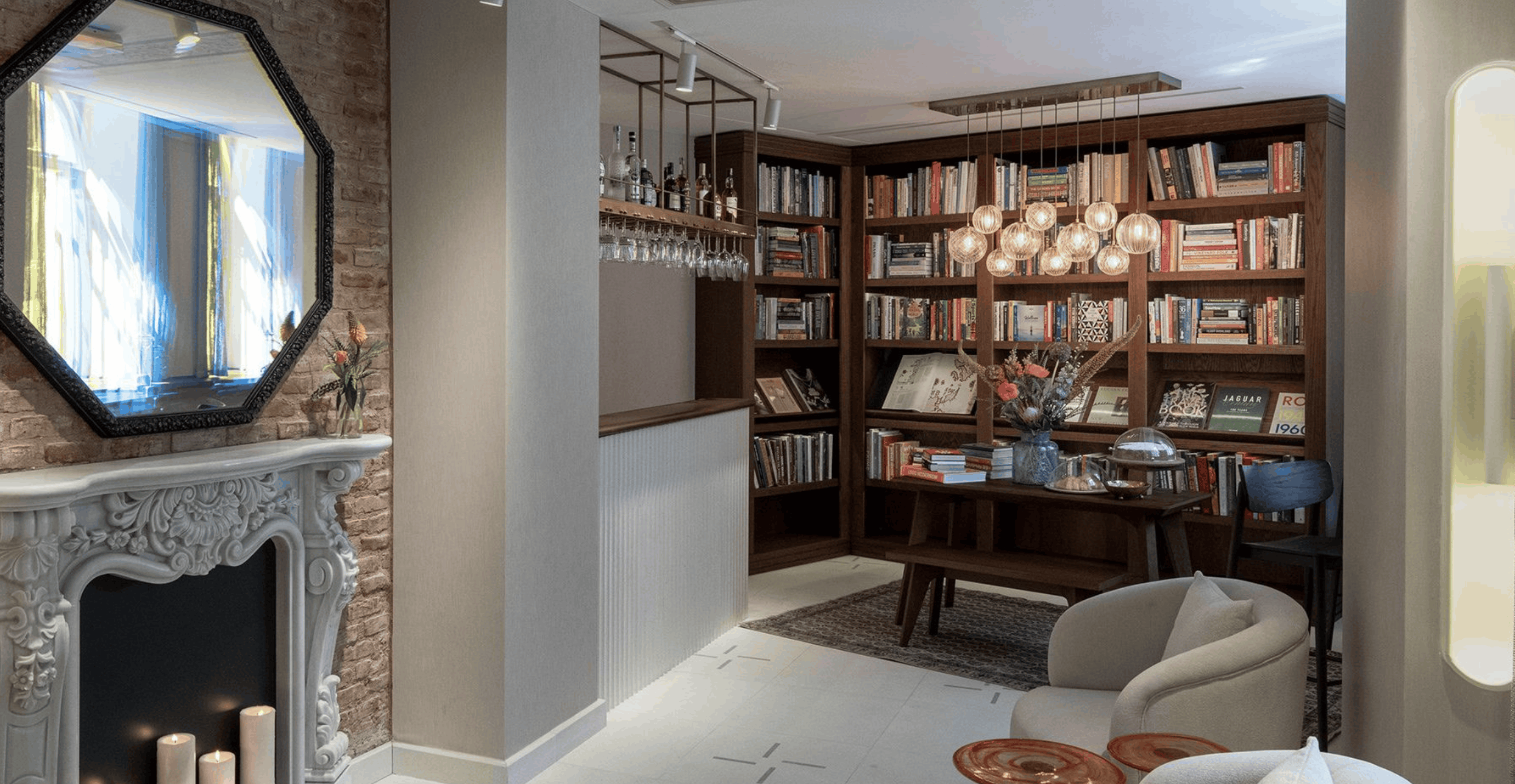
The building's history came first, and every later decision was checked against it. It shaped the tone of voice on the website. It also shaped the rooms, where we kept the original high ceilings, stone walls and the central spiral staircase, and reused the old wooden front door and marble stairs at the entrance. The art follows the same thinking. Work by Turkish artists hangs in the rooms and public spaces, Merve Şendil's woven pieces spelling "HI" and "BYE" sit by the reception desk, and the lower-floor dining area doubles as an exhibition space. On the ground floor, the Minoa Library is a café where guests can borrow or buy books.
None of this needed a meeting between three firms, because there was only one firm in the room. When the menu had to suit the room it would be read in, the people who designed the room also wrote the menu.
The results have been good. The Michelin Guide has added Casa Foscolo to its Istanbul hotel selection. The owners point to a place on The Times' list of the 30 best new hotels, a 4.9 rating on Google Maps, and a hotel that is almost always full. They also tell us the financial returns are ahead of what they expected. We can't say all of that comes from design. The Pera location, a good operating team and the Design Hotels distribution all play a part.
What we can say is that the owners never paid for three firms to argue about the guest experience, and a guest gets the same story on the website as they do in the room.
What changes for the owner
The first thing that changes is the brief. With three consultants, you write three briefs, and each one drifts a little from the others. Most owners don't have time to reconcile three sets of recommendations, so they end up choosing between them in meetings, often on instinct. With one creative lead, you write the brief once and the agency carries it through the brand, the website and the building.
Accountability gets simpler too. Say the website promises a calm, residential stay and the lobby feels like an airport lounge. With one agency, you know who to call. With three, each firm can reasonably say it delivered what it was briefed to deliver.
Decisions also get made once. A colour chosen for the brand is already in the material schedule. The website photography is planned while the rooms are still on drawings, so the photographer shoots what the designer intended.
It also becomes easier to tie design to commercial numbers. The brand decides which guests the hotel attracts. The website decides how easily they book direct, which matters when OTA commission usually takes 15 to 25% of the room rate.
The rooms and the service decide what guests write in their reviews, and review scores feed straight back into the rate a hotel can charge. The hotel's digital journey and the physical stay are parts of one experience, so it makes sense for one agency to answer for them together. When one agency owns all of this, you can hold it to one agreed set of numbers before work starts, which is the approach we set out in our piece on measuring design impact with hotel KPIs.
Separate specialists still have real strengths. A dedicated digital agency may know booking engines better than a creative lead agency does, and a large interiors practice may have deeper technical teams. The cost of using them is the time spent coordinating between them, and most of that time comes out of the owner's week.
When one agency is the wrong choice
This model doesn't suit every project, and some owners are better served by separate specialists. Very large mixed-use projects are the clearest example. A 400-key resort with branded residences, a spa, half a dozen restaurants and a retail podium needs more specialist depth than most creative agencies hold, which is part of why firms like WATG and HBA run such large teams. On a project of that size, one creative lead can still set the brand and the guest journey, but individual outlets will probably need their own specialists.
Flagged conversions are another poor fit. If you are converting a property to a Hilton, Marriott or IHG brand, the brand already exists and arrives with a standards manual. The job is to fit the building to those standards, and the brand's own design team will review every drawing, so a creative lead agency has much less to add. Soft brands such as Design Hotels or Autograph Collection work differently, because the hotel keeps its own name and identity.
Some owners want to keep the brand in-house. A family group with a strong marketing team, or an operator building its own portfolio brand, may only want an outside firm for the interiors. That is a reasonable choice if someone inside the business has the time and the authority to coordinate the outside firms.
Putting everything with one agency also puts a lot of weight on one relationship. If that relationship goes wrong, you lose more than one consultant. Before you hire, look at finished projects where the brand, the website and the building all came from the same team, and talk to those owners.
For an independent or soft-branded hotel with a new brand and no large in-house team, we think one creative lead is the better way to run the project, because the guest experience no longer depends on three firms agreeing with each other.